Published
Digital wedding invitations: what to send to whom
Plan digital wedding invitations alongside paper, with a Bath example covering guest preferences, matching wording and clear RSVP instructions.
Send digital wedding invitations alongside paper at least 12 weeks before the wedding, following Debrett’s usual invitation timing. In this fictional Bath example, Emily and James send digital wedding invitations to Olivia and Oliver, who request email, and paper to Sophie and Harry. Sophie and Harry request print. Replies are usually due two months before the day.
Digital wedding invitations: Emily and James’s guest-by-guest decision
Emily and James start with stated preferences: Olivia and Oliver request email; Sophie and Harry request print; Charlotte and Jack request email.
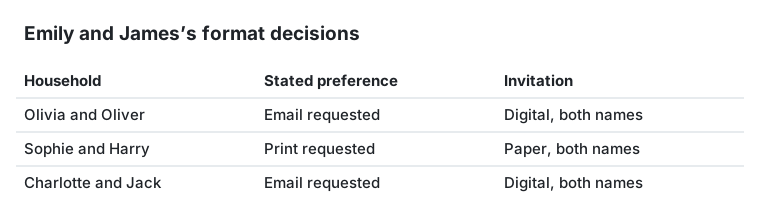
For Olivia and Oliver, Emily and James address the digital invitation to both names. For Sophie and Harry, they put both names on the paper invitation. Charlotte and Jack also receive a digital invitation addressed to both.
Debrett’s says a married guest’s spouse or established long-term partner should be invited. In Emily and James’s example, each pair has an established relationship.
Emily and James use those relationships to decide whose names appear, while the guests’ requests determine the format. Sophie and Harry’s paper preference does not give them a different event from Olivia and Oliver. Emily and James make no allocation by age, and they do not treat email as a less formal invitation.
Put both formats on the same dated timeline
Lucy Hume’s wedding timeline describes three to six months beforehand as ample time for save-the-date cards. Emily and James choose 18 March 2027 for their Bath save-the-date, six months before their wedding.
Save the date: Emily and James are getting married in Bath on 18 September 2027.
Invitation to follow. No reply needed.
Debrett’s says guests’ names do not appear on save-the-date cards. Guests need not reply to a save-the-date card.
Emily and James send both invitation formats on 19 June 2027, giving their guests thirteen weeks before the wedding. Their shared reply deadline is 18 July 2027, two months before their Bath wedding.
In Emily and James’s planning notes, March means an announcement, June means an invitation, and July means replies due. They do not mark Olivia and Oliver as attending merely because they received the March announcement. Sophie and Harry’s printed invitation carries the same reply deadline as the email version.
Use matching invitation wording, with the correct names
Emily and James use this digital wording excerpt:
Olivia and Oliver, please join Emily and James for our wedding in Bath on 18 September 2027.
Emily and James’s ceremony starts at 14:00; please arrive by 13:30.
Join Emily and James for the wedding breakfast and reception afterwards.
Emily and James are having an adults-only wedding.
Please email Emily by 18 July 2027 with a reply for each of you.
Their paper variation changes the opening to “Sophie and Harry” and ends with this instruction:
Sophie and Harry, please reply to Emily by post by 18 July 2027 with a reply for each of you.
Emily and James retain the Bath date, ceremony time and arrival request across both versions. Emily and James deliberately omit the venue address and Emily’s contact details from these Bath excerpts. Before sending, Emily and James would add the venue address, Emily’s email address to the digital version, and her postal address to the paper version.
Debrett’s says couples having an adults-only wedding must make that clear when sending invitations. In British usage, the wedding breakfast is the celebratory meal after the wedding, rather than normally a morning meal. Debrett’s advises guests to arrive at least 30 minutes before the ceremony.
For Emily and James, 13:30 therefore gives guests half an hour before their 14:00 ceremony.
Give each household a clear RSVP route and record each reply
Emily and James ask Olivia and Oliver to reply by email, while Sophie and Harry receive postal instructions. Olivia and Oliver’s fictional response reads:
Emily and James, Olivia is delighted to accept your invitation for 18 September 2027 in Bath.
Oliver is sorry that he cannot attend.
Emily records Olivia as accepted and Oliver as declined on 10 July 2027. She records Sophie and Harry as accepted on 12 July 2027. Charlotte and Jack remain marked “Awaiting reply” against the shared 18 July 2027 deadline.
The specific mistake in Emily’s example would be marking Oliver as attending because Olivia accepted. Her record keeps separate answers beneath the household invitation, rather than turning Olivia’s acceptance into an answer for both.
Debrett’s treats an RSVP acceptance as a commitment that should be honoured. Emily and James’s example record distinguishes that acceptance from Charlotte and Jack’s unanswered invitation.
Make day and evening invitations describe the right event
Debrett’s says inviting someone to the ceremony without the reception is never acceptable. Its suggested arrangement for day and evening guests pairs a sit-down daytime meal with a simple evening buffet.
As an alternative, Emily and James could send Charlotte and Jack this evening wording:
Charlotte and Jack, please join Emily and James for our evening wedding reception in Bath on 18 September 2027, from 19:00.
Emily and James will serve a buffet.
Please email Emily by 18 July 2027 with a reply for each of you.
In this alternative, Charlotte and Jack receive an evening invitation instead of the earlier day invitation. Charlotte and Jack’s 19:00 arrival replaces the ceremony details; their requested digital format stays the same.
For Emily and James’s alternative, use the evening invitation wording guide to develop the evening excerpt. Keep Charlotte and Jack’s alternative allocation alongside the notes on planning invitations for evening guests.
BigDaySite editorial team